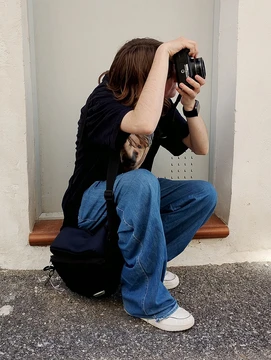
Nan Goldin
American photographer and activist documenting intimacy and subcultures.

via Wikipedia: Nan Goldin · see source
Nan Goldin (born 1953) is an American photographer and activist. Her work explores in snapshot-style the emotions of the individual, in intimate relationships, and the bohemian LGBT subcultural communities, especially dealing with the devastating HIV/AIDS crisis of the 1980s. Her most notable work is The Ballad of Sexual Dependency. In the slideshow and monograph (1986) Goldin portrayed her chosen family, meanwhile documenting the post-punk and gay subcultures. She is a founding member of the advocacy group P.A.I.N. (Prescription Addiction Intervention Now) against the opioid epidemic. She lives and works in New York City.
- born
- 1953
- field
- Photography, activism
- nationality
- American
- known_for
- The Ballad of Sexual Dependency, documenting LGBT subcultures and HIV/AIDS crisi
Verified Timeline
Lore & Background
Goldin's first solo show, held in Boston in 1973, was based on her photographic journeys among the city's gay and transgender communities, to which she had been introduced by her friend David Armstrong. While living in downtown Boston at age 18, Goldin 'fell in with the drag queens,' living with them and photographing them. Goldin said, 'My desire was to show them as a third gender, as another sexual option, a gender option. And to show them with a lot of respect and love, to kind of glorify them because I really admire people who can re-create themselves and manifest their fantasies publicly. I think it's brave.' She graduated from the School of the Museum of Fine Arts in 1977/1978. Following graduation, Goldin moved to New York City. She began documenting the post-punk new-wave music scene, along with the city's vibrant, post-Stonewall gay subculture of the late 1970s and early 1980s. Her first slideshow in New York was at the birthday party of Frank Zappa at the Mudd Club. A first exposure to a wider audience was her participation in the 1981 exhibition New York/New Wave at PS1.
Reader's Guide
Nan Goldin's most notable work is The Ballad of Sexual Dependency, a slideshow and monograph (1986) that documents her chosen family and the post-punk and gay subcultures. The photographs were taken between 1979 and 1986. Later versions of the cycle had around 700 images screened in about 45 minutes (ca. 3 seconds per slide). After the slideshow was screened at the Whitney Biennial in 1985, it was published as a book a year later by Aperture. The snapshot aesthetic images were dominantly taken indoors and by night: 'That series is stark. It's all flash-lit. I honestly didn't know about natural light then and how it affected the colour of the skin because I never went out in daylight.' They depict autobiographical moments, mostly of friends, women and men for themselves and couples, often nude, some casual, some explicit. Her self-portrait, 'Nan One Month After Being Battered, 1984', was called the center-piece of the Ballad. In her foreword to the book she describes it as a 'diary [she] lets people read' of people she referred to as her 'tribe'. Most of her Ballad subjects were dead by the 1990s, lost either to drug overdose or AIDS; this tally included close friends and often-photographed subjects Greer Lankton and Cookie Mueller. In 1989, six days after Mueller's death, Goldin's show 'Witnesses: Against Our Vanishing' opened in New York, a multi-artist show at Artists Space dealing frankly with issues related to living and dying with HIV/AIDS.
Did You Know?
- Goldin began photographing at age 16 after Polaroid donated cameras to her school, and a staff member (existential psychologist Rollo May's daughter) introduced her to photography in 1969.
- Her first solo show in Boston in 1973 was based on her photographic journeys among the city's gay and transgender communities, introduced by her friend David Armstrong.
- The title The Ballad of Sexual Dependency is taken from a song in Bertolt Brecht's Threepenny Opera.
- Goldin's self-portrait 'Nan One Month After Being Battered, 1984' was called the center-piece of the Ballad.
- In 1989, six days after Cookie Mueller's death, Goldin's show 'Witnesses: Against Our Vanishing' opened at Artists Space, dealing frankly with HIV/AIDS.
Frequently Asked Questions
Who is Nan Goldin?
She is an American photographer and activist born in 1953, best known for capturing raw, personal moments within close relationships and underground communities. Her career spans both fine-art photography and public advocacy.
What is The Ballad of Sexual Dependency?
Released in 1986, it is her landmark slideshow-and-book project that chronicles her inner circle of friends and lovers amid the post-punk and gay scenes of the era. It became one of the most recognized works in contemporary photography.
How did Nan Goldin become involved in the opioid crisis?
After her own family was devastated by prescription drug addiction, she helped establish P.A.I.N. (Prescription Addiction Intervention Now) as a grassroots group pushing for policy reform. She became a vocal public face against the pharmaceutical industry's role in the epidemic.
What themes run through Nan Goldin's photography?
Her images consistently center on vulnerability, queer identity, and the lived reality of communities hit hard by the HIV/AIDS crisis of the 1980s. She treats her subjects as chosen family rather than distant sitters.
Why do fans and critics consider Nan Goldin significant?
She bridged the gap between personal diary-like imagery and a broader cultural record of subcultures that mainstream media largely ignored. Her willingness to pair artistic practice with direct political action set a model that many later photographers and activists have followed.
More in Photographers 1-24
Elsewhere in the Photographers universe
Spotted an error? Know more?
This is a living reference — every entry is fact-audited, and reader corrections feed straight into our audit queue. Suggest an edit · See this site's audit record