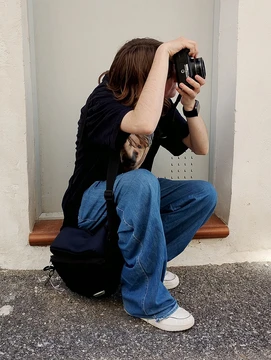
Robert Mapplethorpe
American photographer known for black-and-white photographs and controversial images of the gay male BDSM subculture.

Robert Marin from Ljubljana, Slovenia · CC BY 2.0
Robert Michael Mapplethorpe (November 4, 1946 – March 9, 1989) was an American photographer, best known for his black-and-white photographs. His work featured an array of subjects, including celebrity portraits, male and female nudes, self-portraits, and still-life images. His most controversial works documented and examined the gay male BDSM subculture of New York City in the late 1960s and early 1970s. Mapplethorpe's 1989 exhibition, Robert Mapplethorpe: The Perfect Moment, sparked a debate in the United States concerning both the use of public funds for "obscene" artwork and the Constitutional limits of free speech in the United States.
- born
- November 4, 1946, Floral Park, Queens, New York City
- died
- March 9, 1989, Boston, Massachusetts
- field
- Photography
- nationality
- American
- known_for
- Black-and-white photographs; controversial images of gay male BDSM subculture; c
Verified Timeline
Lore & Background
Mapplethorpe was born in the Floral Park neighborhood of Queens, New York City, to Joan Dorothy (Maxey) and Harry Irving Mapplethorpe, an electrical engineer. He was of English, Irish, and German descent and grew up as a Catholic at Our Lady of the Snows Parish. He attended Martin Van Buren High School, graduating in 1963, and later the Pratt Institute in Brooklyn, where he majored in Graphic Arts but dropped out in 1969. In 1967, he began living with artist and musician Patti Smith, who supported him by working in bookstores; they created art together and maintained a close friendship after their romance ended in 1970. In the late 1960s and early 1970s, he designed and sold handmade jewelry composed of religious and symbolic charms, modeled by Warhol superstars Ultra Violet, Jay Johnson, and Joe Dallesandro. He also produced drawings, collages, and found-object sculptures, gradually incorporating photography into his collages. Mapplethorpe's boyfriend David Croland introduced him to John McKendry, curator of photographs and prints at the Metropolitan Museum of Art, who gave him a Polaroid camera as a Christmas gift in 1971 and introduced him to the Polaroid Corporation's Artist Support Program. In 1972, Croland introduced him to art curator Sam Wagstaff, who became his mentor, patron, and lover. When Patti Smith moved in with her boyfriend Allen Lanier, Wagstaff provided Mapplethorpe with $15,000 to purchase a loft at 24 Bond Street. In January 1973, his first solo gallery exhibition was mounted at the Light Gallery in New York City. Wagstaff later gave him a Hasselblad medium-format camera. Mapplethorpe befriended New Orleans artist George Dureau, whose work had such a profound impact that he restaged many of Dureau's early photographs. From 1977 until 1980, he was the lover of writer and Drummer editor Jack Fritscher, who introduced him to the Mineshaft, a members-only BDSM gay leather bar and sex club in Manhattan, where Mapplethorpe became its official photographer. In 1980, Mapplethorpe met Milton Moore, who was AWOL from the U.S. Navy, at the gay bar Sneakers in the West Village. Moore became his muse; Mapplethorpe supported him financially, paid his legal expenses, and encouraged him to study photography at Parsons School of Design. After Moore left, Mapplethorpe began a relationship with Jack Walls, a clerk-typist from Chicago, who became his muse. After his romance with Wagstaff ended, Wagstaff gave Mapplethorpe $500,000 to purchase a top-floor loft at 35 West 23rd Street, where he resided and used as a photo-shoot studio, keeping the Bond Street loft as his darkroom. After being diagnosed with AIDS in 1986, Mapplethorpe intensified his artistic production despite his declining health. He was the principal inheritor of Wagstaff's fortune and executor of his estate after Wagstaff died in 1987. In 1988, the Whitney Museum of American Art mounted his first major American museum retrospective. That year, he selected Patricia Morrisroe to write his biography, based on more than 300 interviews. Mapplethorpe died on March 9, 1989, at age 42 due to complications from HIV/AIDS in a Boston hospital; his body was cremated, and his ashes are interred at St. John's Cemetery, Queens, at his mother's gravesite, etched "Maxey."
Reader's Guide
Robert Mapplethorpe's significance lies in his ability to merge explicit erotic imagery with high-art photography, challenging conventions of obscenity and free speech. His work, primarily black-and-white, spanned celebrity portraits, nudes, self-portraits, and still-life images, but his most controversial pieces documented the gay male BDSM subculture of New York City in the late 1960s and early 1970s. The 1989 exhibition Robert Mapplethorpe: The Perfect Moment ignited a national debate over public funding for "obscene" artwork and the Constitutional limits of free speech in the United States. Mapplethorpe's legacy is also tied to his patronage by Sam Wagstaff, who provided financial support and a Hasselblad camera, and his relationships with figures like Patti Smith, who was a frequent subject. His work often made reference to religious or classical imagery, such as a 1975 portrait of Smith from 1986 which recalls Albrecht Dürer's 1500 self-portrait. He incorporated pornography into his work with the aim of arousing the viewer, but which could also be regarded as high art. Mapplethorpe's influence persists in discussions of art, censorship, and LGBTQ+ representation. As Patti Smith recalled, "Robert took areas of dark human consent and made them into art. He worked without apology, investing the homosexual with grandeur, masculinity, and enviable nobility." His final years were marked by intensified production after his AIDS diagnosis in 1986, and his estate inherited Wagstaff's fortune.
Did You Know?
- Mapplethorpe's first camera was a Polaroid given to him as a Christmas gift in 1971 by John McKendry, curator at the Metropolitan Museum of Art.
- Sam Wagstaff gave Mapplethorpe $15,000 to purchase a loft at 24 Bond Street and later $500,000 for a top-floor loft at 35 West 23rd Street.
- Mapplethorpe was the official photographer of the Mineshaft, a members-only BDSM gay leather bar and sex club in Manhattan.
- His 1986 photograph of Andy Warhol sold for $643,200 in 2006, making it the most expensive Mapplethorpe photograph ever sold.
- Mapplethorpe's ashes are interred at St. John's Cemetery, Queens, at his mother's gravesite, etched with the word 'Maxey'.
Roots and Early Creative Life
Born in the Floral Park neighborhood of Queens, New York City, to Joan Dorothy (Maxey) and Harry Irving Mapplethorpe, an electrical engineer, Robert Michael Mapplethorpe grew up as a Catholic at Our Lady of the Snows Parish, carrying English, Irish, and German heritage. He had three brothers and two sisters; one brother, Edward, later worked for him as an assistant and became a photographer as well. After graduating from Martin Van Buren High School in 1963, he attended the Pratt Institute in Brooklyn, where he majored in Graphic Arts, dropping out in 1969 before finishing his degree. In the late 1960s and early 1970s, his creative output was strikingly eclectic: he designed and sold handmade jewelry composed of religious and symbolic charms, made from found materials that evolved to include beads, dice, feathers, rabbits' feet, silver skulls, and crosses, reflecting his Baroque sense of style. His jewelry was modeled by Warhol superstars Ultra Violet, Jay Johnson, and Joe Dallesandro. He also produced drawings, collages, and found-object sculptures, gradually incorporating photography into his collages. Mapplethorpe is said to have drawn inspiration from George Dureau, an American black and white photographer ten years his senior, who composed shots of fully nude African American and disabled men in his home city of New Orleans.
The Making of a Photographer
Mapplethorpe's shift into fine photography was set in motion by a series of pivotal introductions. His boyfriend David Croland introduced him to John McKendry, curator of photographs and prints at the Metropolitan Museum of Art, who invited him to study the museum's collection and, as a Christmas gift in 1971, gave him a Polaroid camera. McKendry then introduced him to executives at the Polaroid Corporation in Boston, whose Artist Support Program provided cameras and film to selected artists. In 1972, Croland introduced him to Sam Wagstaff, who became his mentor, patron, and lover. When Patti Smith—his former girlfriend and collaborator, with whom he had shared an apartment since 1967—moved in with her boyfriend, musician Allen Lanier, Mapplethorpe faced losing the financial support that had enabled him to remain in their apartment. Wagstaff stepped in with $15,000 to purchase a loft at 24 Bond Street, a few doors from Wagstaff's own apartment. Around this time, Wagstaff gave him a Hasselblad medium-format camera, and Mapplethorpe began photographing a wide circle of friends and acquaintances, including artists, composers, and socialites. His first solo gallery exhibition opened at the Light Gallery in New York City in January 1973. By February 1977, gallerist Holly Solomon was representing him after commissioning him to make her portrait, showing his portraits at her gallery while his erotic photographs were shown separately at The Kitchen, a nonprofit art space in SoHo.
The Mineshaft Years and the Fight Over Censorship
From 1977 until 1980, Mapplethorpe was in a relationship with writer and Drummer editor Jack Fritscher, who introduced him to the Mineshaft, a members-only BDSM gay leather bar and sex club in Manhattan. Mapplethorpe photographed the space extensively and at one point served as its official photographer, documenting the gay male BDSM subculture of New York City in the late 1960s and early 1970s. These images, alongside his broader body of work featuring male and female nudes, celebrity portraits, self-portraits, and still-life compositions, became the core of his artistic identity. His 1989 exhibition, Robert Mapplethorpe: The Perfect Moment, ignited a fierce national debate in the United States over whether public funds should support artwork deemed "obscene" and where the Constitutional limits of free speech actually lay. The controversy placed Mapplethorpe at the center of a cultural battle that extended far beyond the art world, pitting institutional funding and censorship against the right to artistic expression.
Final Years and the Weight of Legacy
After receiving an AIDS diagnosis in 1986, Mapplethorpe did not slow down; instead, he intensified his artistic output even as his health steadily declined. In 1987, Sam Wagstaff died, and Mapplethorpe, as principal inheritor and executor of Wagstaff's estate, had earlier received a $500,000 gift that funded his top-floor loft at 35 West 23rd Street, where he lived and shot, while keeping the Bond Street loft as his darkroom. In 1988, the Whitney Museum of American Art mounted his first major American museum retrospective, and that same year he selected Patricia Morrisroe to write his biography, a project built on more than 300 interviews with celebrities, critics, lovers, and Mapplethorpe himself. On March 9, 1989, at age 42, Mapplethorpe died of complications from HIV/AIDS in a Boston hospital. His body was cremated, and his ashes were interred at St. John's Cemetery, Queens, in New York City, at his mother's gravesite, etched "Maxey." His legacy endures as a figure whose black-and-white photographs—spanning nudes, celebrity portraits, still lifes, and the raw documentation of New York's gay male BDSM subculture—continue to provoke, inspire, and challenge.
Gallery
Frequently Asked Questions
Who is Robert Mapplethorpe?
Robert Mapplethorpe (1946–1989) was an American photographer born in Floral Park, Queens, New York, best remembered for his meticulously composed black-and-white images. His career spanned celebrity portraits, nudes, self-portraits, and floral still lifes, making him one of the most visually distinctive photographers of the late twentieth century.
What subjects did Mapplethorpe photograph?
His portfolio includes portraits of well-known figures, male and female nudes, self-portraits, and detailed still-life studies of flowers and objects. He also produced a body of work documenting the gay male BDSM subculture in New York City during the late 1960s and early 1970s, which became the most debated part of his legacy.
Why was Mapplethorpe so controversial?
His explicit depictions of gay male BDSM and unapologetic nudes provoked strong moral and political backlash. The controversy culminated in a national fight over whether federal arts funding could legally support work critics labeled obscene, turning his photography into a constitutional and cultural battleground.
What was the 1989 exhibition 'The Perfect Moment'?
It was a major retrospective of Mapplethorpe's career that opened in 1989 and quickly became the center of a heated U.S. debate about public funding of provocative art. The show's inclusion of his most explicit images drew congressional hearings and legal challenges that reshaped discussions of artistic free expression.
When and where did Robert Mapplethorpe die?
He died on March 9, 1989, in Boston, Massachusetts, at the age of forty-two. His death from AIDS-related complications came only months after the Perfect Moment controversy had captured the attention of the entire country.
More in Photographers 1-24
Elsewhere in the Photographers universe
Spotted an error? Know more?
This is a living reference — every entry is fact-audited, and reader corrections feed straight into our audit queue. Suggest an edit · See this site's audit record