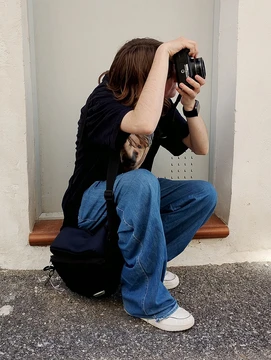
Diane Arbus
American photographer who expanded acceptable subject matter in portraiture.

Idris2000 · CC BY-SA 4.0
Diane Arbus (née Nemerov; March 14, 1923 – July 26, 1971) was an American photographer. She photographed a wide range of subjects including strippers, carnival performers, nudists, people with dwarfism, children, mothers, couples, elderly people, and middle-class families. She photographed her subjects in familiar settings: their homes, on the street, in the workplace, in the park. She is noted for expanding notions of acceptable subject matter and violates canons of the appropriate distance between photographer and subject. By befriending, not objectifying her subjects, she was able to capture in her work a rare psychological intensity.
- born
- March 14, 1923
- died
- July 26, 1971
- field
- Photography
- nationality
- American
- known_for
- Portraits of marginalized and unconventional subjects; expanding acceptable subj
Verified Timeline
Lore & Background
Diane Arbus was born Diane Nemerov to David Nemerov and Gertrude Russek Nemerov, Jewish immigrants from Soviet Russia and Poland, who lived in New York City. They owned Russeks, a Fifth Avenue women's wear department store, co-founded by Arbus's grandfather Frank Russek, a Polish-Jewish immigrant. Because of her family's wealth, Arbus was insulated from the effects of the Great Depression while growing up in the 1930s. Her parents were not deeply involved in raising their children, who were overseen by maids and governesses. Her mother underwent a period of clinical depression for approximately a year. Diane separated herself from her family and her lavish childhood. She attended the Ethical Culture Fieldston School. After marrying Allan Arbus, she received her first camera, a Graflex, and shortly thereafter enrolled in classes with photographer Berenice Abbott. In the early 1940s, Diane's father employed Diane and Allan to take photographs for the department store's advertisements. In 1946, after the war, the Arbuses began a commercial photography business called 'Diane & Allan Arbus', with Diane as art director and Allan as the photographer. She grew dissatisfied with this role, a role even her husband thought was 'demeaning'. In 1956, encouraged by her studies with Lisette Model, Arbus quit the commercial photography business and began numbering her negatives. Her last known negative was labeled #7459.
Reader's Guide
Arbus's significance lies in her transformation of photography through her choice of subjects and her approach. Arthur Lubow stated she 'was fascinated by people who were visibly creating their own identities—cross-dressers, nudists, sideshow performers, tattooed men, the nouveaux riches, the movie-star fans—and by those who were trapped in a uniform that no longer provided any security or comfort.' Michael Kimmelman writes that her work 'transformed the art of photography (Arbus is everywhere, for better and worse, in the work of artists today who make photographs)'. In 1963 the Guggenheim Foundation awarded Arbus a fellowship for her proposal entitled 'American Rites, Manners and Customs'; she was awarded a renewal in 1966. John Szarkowski included her work in his 1967 exhibit New Documents at MoMA along with Lee Friedlander and Garry Winogrand. In 1972, a year after her suicide, Arbus became the first photographer to be included in the Venice Biennale where her photographs were 'the overwhelming sensation of the American Pavilion' and 'extremely powerful and very strange'. The first major retrospective at MoMA in 1972, organized by Szarkowski, garnered the highest attendance of any exhibition in MoMA's history to date. Millions viewed traveling exhibitions of her work from 1972 to 1979. The book accompanying the exhibition, Diane Arbus: An Aperture Monograph, edited by Doon Arbus and Marvin Israel and first published in 1972, has never been out of print.
Did You Know?
- Arbus's last known negative was labeled #7459.
- She was the first photographer ever included in the Venice Biennale, in 1972.
- Her first camera, a Graflex, was given to her by her husband Allan shortly after they married.
- In 1963 the Guggenheim Foundation awarded her a fellowship for a project titled 'American Rites, Manners and Customs', which was renewed in 1966.
- The 1972 MoMA retrospective of her work garnered the highest attendance of any exhibition in the museum's history to that date.
Career & Institutional Recognition
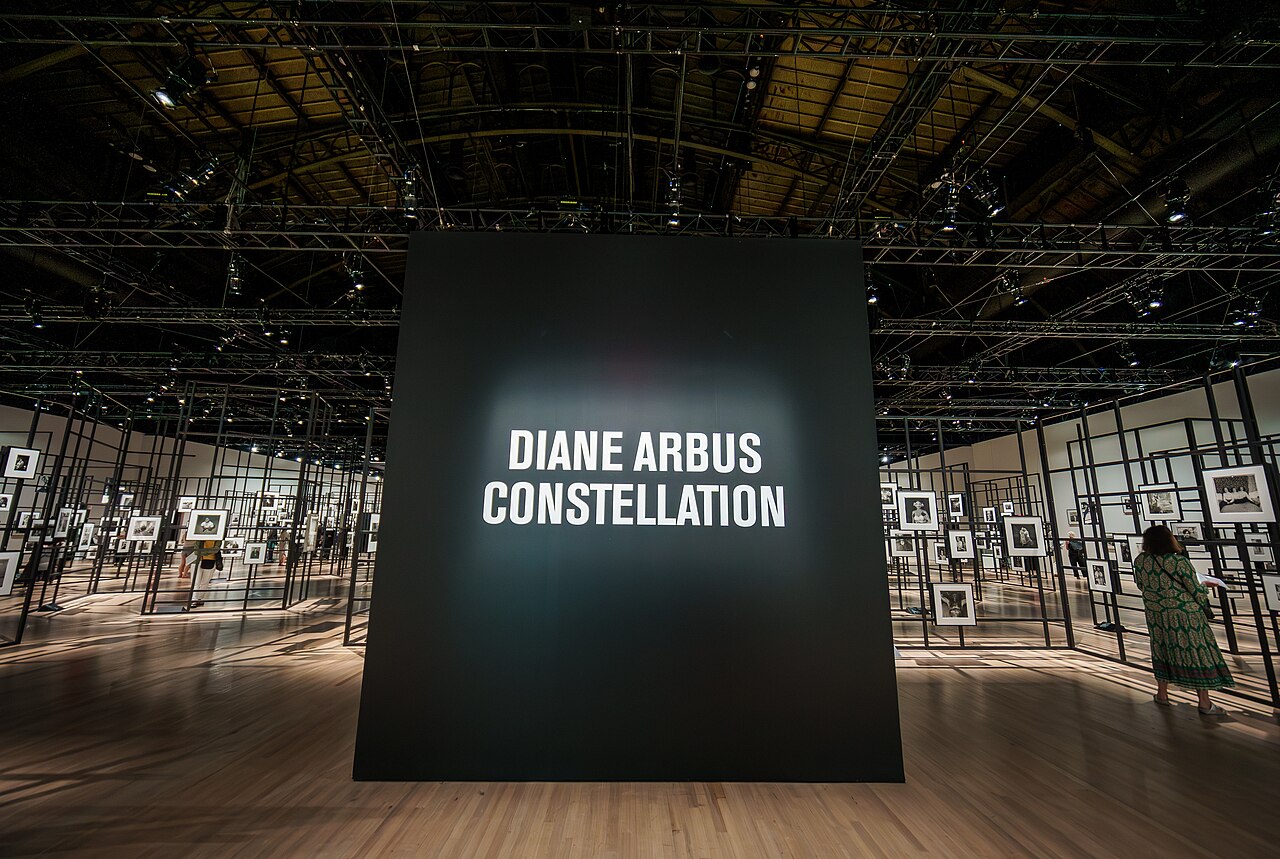
Arbus's professional trajectory shifted dramatically after she left the commercial studio she had run with her husband Allan. Beginning in 1960, her photographs appeared in publications including Esquire, Harper's Bazaar, London's Sunday Times Magazine, and Artforum. In 1963, the Guggenheim Foundation granted her a fellowship to pursue a project she titled 'American Rites, Manners and Customs'; she was awarded a renewal in 1966. The defining institutional validation came in 1967, when John Szarkowski, then director of photography at the Museum of Modern Art, selected her work for the landmark group exhibition New Documents, placing her alongside Lee Friedlander and Garry Winogrand. Her posthumous recognition was equally seismic: in 1972, a year after her death, she became the first photographer ever included in the Venice Biennale, where her images were described as 'the overwhelming sensation of the American Pavilion' and 'extremely powerful and very strange'. That same year, MoMA mounted a major retrospective organized by Szarkowski that drew the highest attendance of any exhibition in the museum's history to that point. Millions viewed traveling exhibitions of her work from 1972 to 1979.
Artistic Philosophy & Method
Arbus's approach to photography was shaped profoundly by her mentor Lisette Model, whose instruction began in 1956 and prompted Arbus to quit commercial work entirely. Based on Model's advice, Arbus spent time with an empty camera so she could practice observation. Arbus also credits Model with making it clear to her that 'the more specific you are, the more general it'll be.' By 1956 she worked with a 35mm Nikon, wandering the streets of New York City and meeting her subjects largely, though not always, by chance. Around 1962, Arbus switched from a 35 mm Nikon camera to a twin-lens reflex Rolleiflex camera which produced more detailed square images. She explained this transition saying 'I wanted to see the real differences between things ... I began to get terribly hyped on clarity.' In 1964, Arbus began using a 2-1/4 Mamiyaflex camera with flash in addition to the Rolleiflex. Her style is described as 'direct and unadorned, a frontal portrait centered in a square format. Her pioneering use of flash in daylight isolated the subjects from the background, which contributed to the photos' surreal quality.' Her methods included establishing a strong personal relationship with her subjects and re-photographing some of them over many years.
Early Life & Family Context
Diane Nemerov entered the world on March 14, 1923, into a family of Jewish immigrants from Soviet Russia and Poland who had built a comfortable life in New York City. Her parents owned Russeks, a Fifth Avenue women's wear department store, co-founded by her grandfather Frank Russek, a Polish-Jewish immigrant. David Nemerov rose to become chairman of the store. The family's wealth insulated Diane from the effects of the Great Depression while growing up in the 1930s. Yet the household was emotionally distant: her parents were not deeply involved in raising their children, who were overseen by maids and governesses. Her mother had a busy social life and underwent a period of clinical depression for approximately a year, then recovered. Diane's siblings became prominent figures in their own right—her older brother Howard Nemerov taught English at Washington University in St. Louis and was appointed United States Poet Laureate, and her younger sister became a sculptor and designer. Diane attended the Ethical Culture Fieldston School, a college-preparatory school. She later said that the only thing she suffered from as a child was never having felt adversity, which evolved into a longing for things that money couldn't buy, such as experiences in the underground social world.
Legacy & Enduring Influence
Arbus's impact on the photographic field has proven extraordinary. The 1972 MoMA retrospective, organized by Szarkowski, set a record for the highest attendance of any exhibition in the museum's history up to that date. From 1972 through 1979, traveling exhibitions of her work drew millions of viewers across multiple venues. The accompanying volume, Diane Arbus: An Aperture Monograph, edited by Doon Arbus and Marvin Israel and first published in 1972, has never gone out of print. At the 1972 Venice Biennale, her photographs were called 'extremely powerful and very strange,' cementing her status as a singular voice in the medium. Michael Kimmelman, reviewing the exhibition Diane Arbus Revelations, observed that her work 'transformed the art of photography' and that she is 'everywhere, for better and worse, in the work of artists today who make photographs.' By expanding what was considered acceptable subject matter and dissolving the expected distance between photographer and sitter, Arbus opened a lane that countless subsequent artists continue to travel.
Gallery




Frequently Asked Questions
Who is Diane Arbus?
Diane Arbus (born Nemerov, 1923–1971) was an American photographer celebrated for her stark, unflinching portraits of everyday and unconventional people. She is widely regarded as a pioneer who broadened what photography could legitimately depict.
What subjects is Diane Arbus most famous for photographing?
Her well-known body of work includes portraits of carnival performers, people with dwarfism, strippers, nudists, mothers, children, elderly individuals, and ordinary middle-class families. She typically captured these subjects in their own familiar environments—homes, parks, workplaces, or city streets.
What made Diane Arbus's photographic approach distinctive?
Rather than maintaining a clinical or exploitative distance, Arbus built genuine rapport with her sitters, treating them as collaborators rather than objects of curiosity. This intimacy, combined with her deadpan, unadorned framing, challenged the conventional boundaries of who deserved to be a portrait subject.
When was Diane Arbus born and when did she die?
She was born on March 14, 1923, and died on July 26, 1971, at the age of 48. Her relatively short life produced a compact but enormously influential photographic legacy.
Why is Diane Arbus considered important in the history of photography?
Arbus expanded the accepted range of portraiture by giving dignified, direct representation to people society often marginalized or caricatured. Her work helped shift the medium's standards of empathy and subjecthood, influencing generations of photographers who followed.
More in Photographers 1-24
Related in Photographers
Links follow this subject's own source article.
Elsewhere in the Photographers universe
Spotted an error? Know more?
This is a living reference — every entry is fact-audited, and reader corrections feed straight into our audit queue. Suggest an edit · See this site's audit record